

Electronic nicotine distribution programs (ENDS), commonly referred to as vape (vejp), symbolize a substantial change in how nicotine is consumed. Unlike conventional combustion strategies that burn off product to produce smoke, vaping relies on thermodynamics and electric executive to make an aerosol. While the devices range from simple disposables to complex package mods, the fundamental technology stays regular: a battery forces a heating element, which vaporizes a fluid solution.
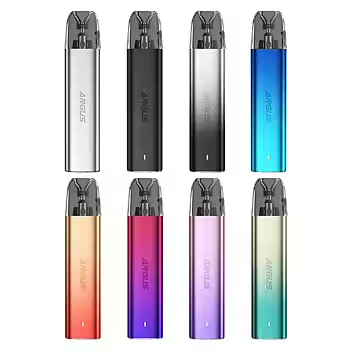
Understanding the aspects behind these devices is required for people and market specialists alike. It gives perception in to security, preservation, and the consumer experience. This complex overview stops working the key components and the science governing modern vape technology.
What governs the power supply system?
At the heart of each vaping device could be the battery, generally a lithium-ion cell. In advanced products, the 18650 battery stays the industry standard because harmony of measurement, volume, and release rate.
The battery's primary function is to deliver recent to the heating element. However, raw energy is seldom sent straight to the coil in modern devices. Alternatively, it passes via a sophisticated regulation system.
• Voltage Regulation: Many typical products operate between 3.2 and 4.2 volts. Advanced chipsets allow for "buck-boost" engineering, which keeps regular voltage output whilst the battery's charge depletes.
• Volume Metrics: Battery life is measured in milliamp-hours (mAh). A standard vape battery stages from 2000mAh to 3000mAh. A greater mAh standing suggests longer runtime, however often at the cost of maximum discharge current (Amperage).
How does atomization arise?
The process of turning e-liquid into vapor—atomization—depends on the concept of Joule heating. When an electrical current goes via a resistive substance (the coil), electrical energy is changed into temperature energy.
The coil creates a managed short circuit. While the steel heats up, it vaporizes the e-liquid held in the wicking substance (usually normal cotton) that works through or about the coil.
• Resistance (Ohms): The resistance of the coil dictates just how much energy is needed. Standard coils (above 1.0 ohm) require less power and reproduce a tighter draw. Sub-ohm coils (below 1.0 ohm) allow for larger wattage and higher steam production.
• Heat Character: To make steam without burning the wick, the coil must reach conditions between 200°C and 250°D (392°F - 480°F) rapidly. Modern temperature get a handle on (TC) methods check the resistance changes in resources like Nickel or Stainless Steel to restrict power after a collection heat is reached, blocking dried hits.
What's the position of the chipset?
In governed mods, the chipset works as the mind of the device. It creates a link involving the battery and the atomizer, ensuring accuracy and safety. The progress of chipsets has moved vaping from a technical hobby to a digitally managed experience.
• Pulse Breadth Modulation (PWM): Many products use PWM to manage power. The chip quickly rounds the energy on and off—thousands of instances per second—to supply an exact normal voltage to the coil.
• Protection Protections: Modern panels contain vital security features. Small circuit security prevents the unit if opposition lowers precariously minimal (often below 0.1 ohms). Over-discharge safety reductions down power once the battery lowers below safe voltage levels (typically 3.2V) to avoid chemical destruction of the battery cell.
• Firing Rate: High-end chipsets now boast firing speeds as quickly as 0.001 seconds, giving near-instantaneous steam generation when the initial button is pressed.
Just how do water character and ventilation influence performance?

The engineering of a vape tank or pod relies heavily on substance dynamics and aerodynamics. The wicking activity is pushed by capillary activity, pulling water from the reservoir to the coil.
Concurrently, airflow design decides the density and heat of the vapor.
• Circulation Intake: As an individual inhales, air is drawn over the coil. That circulation acts two applications: it cools the coil to avoid overheating and combinations with the vaporized water to create the aerosol.
• Viscosity Ratios: The equipment should match the viscosity of the liquid. Propylene Glycerin (PG) is leaner, while Vegetable Glycerin (VG) is thicker. High-wattage tanks have greater wicking slots to handle thick, high-VG drinks, while low-power pods have smaller locations to stop flooding with thinner liquids.
The Potential of Vaporization Engineering
Vaping technology remains to miniaturize while increasing in efficiency. We are seeing a change toward larger energy occurrence in smaller batteries and the usage of mesh rings, which increase the top region for heat without raising power demands. As the industry matures, the concentration stays on precise thermal regulation and battery security, ensuring that the move from liquid to aerosol is really as clean and regular as possible.